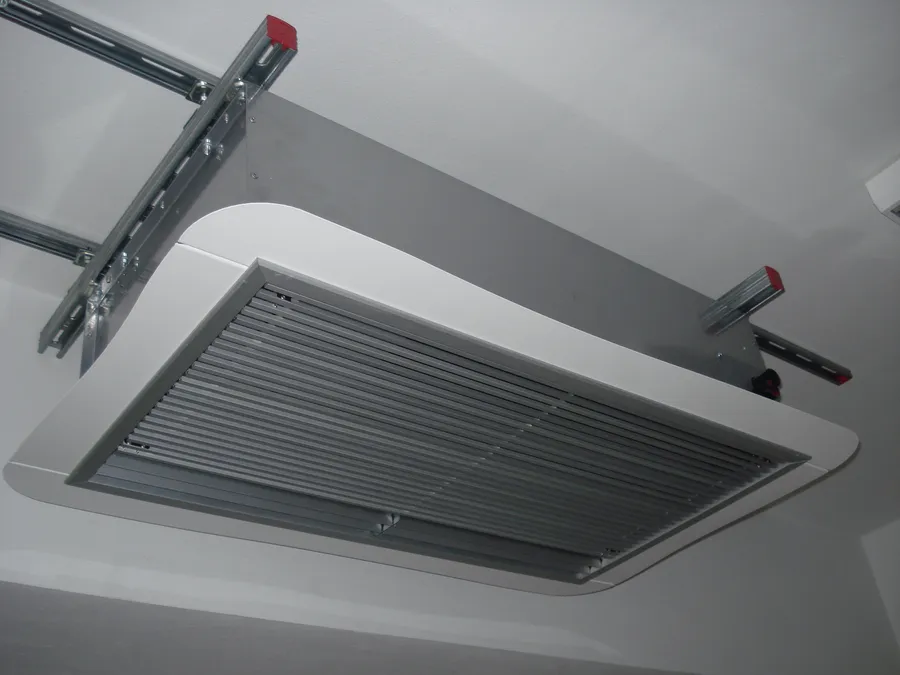
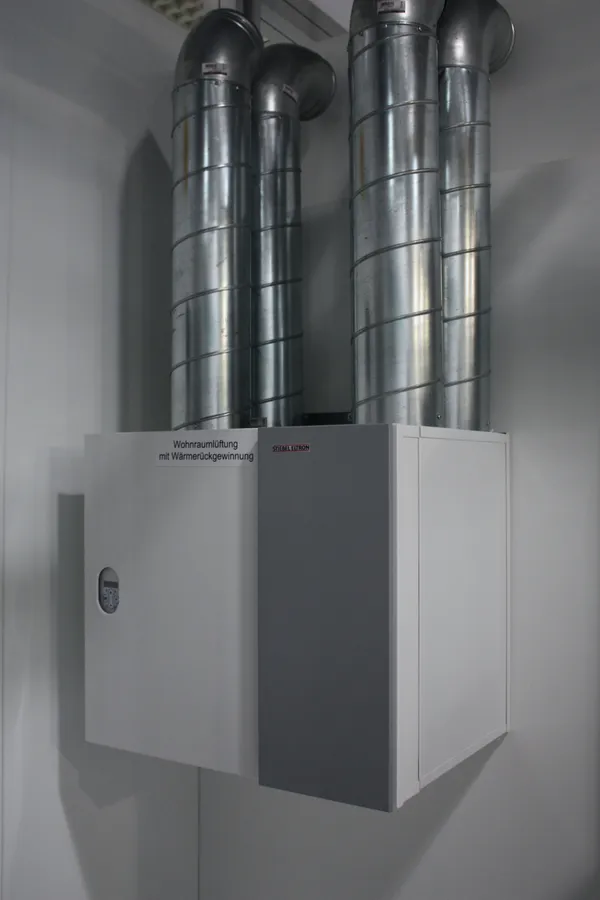
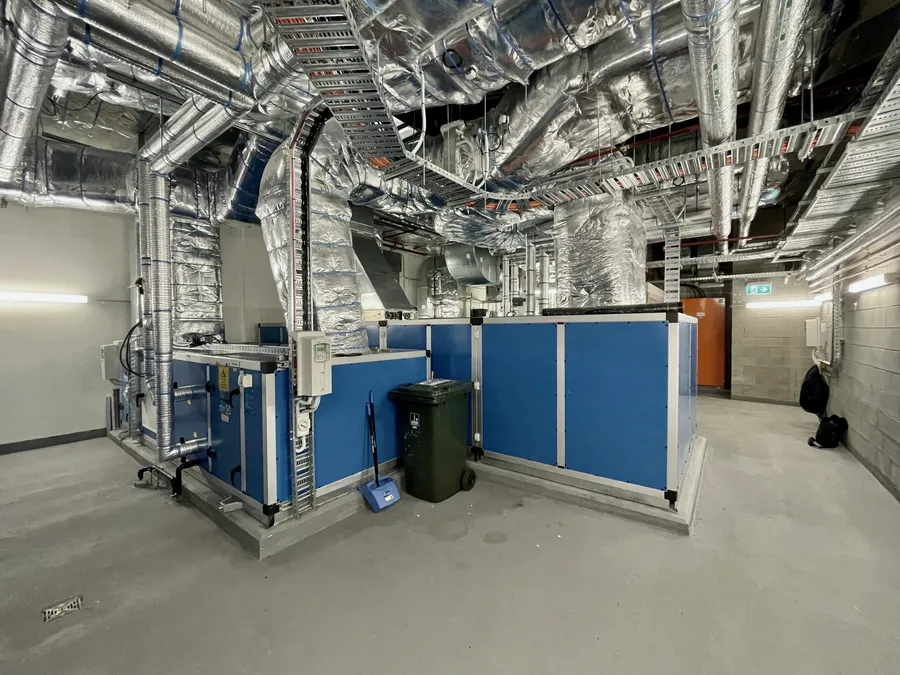
Buildings in the UAE are sealed tightly to keep the heat out, and the air inside goes stale as a result. CO2 rises through the working day and humidity climbs with it. An energy recovery ventilator brings in fresh air and pushes out stale air through a core that transfers heat and moisture between the two streams, so the incoming air arrives partly cooled and dried. A heat recovery ventilator does the same for heat alone. Seven Infra designs and installs both.
What we deliver
| Stage | What we do | Deliverable |
|---|---|---|
| Condition assessment | CO2, humidity and airflow measured in the occupied space | Assessment report |
| Ventilation design | Fresh-air rates per room from occupancy and use, exhaust balance, unit selection | Ventilation schedule |
| Duct routing | Supply and exhaust routes, intake and discharge positions, sound attenuation | Duct layout drawings |
| Energy recovery | ERV or HRV core selection, bypass and control strategy | Equipment schedule |
| Filtration | Pre-filter and fine-filter grades for the site, access for replacement | Filter schedule |
| Installation and commissioning | Units, ductwork, wiring, airflow balancing, CO2 verification | Commissioning report |
Fresh-air rates are set from occupancy, and the exhaust is balanced against the supply so the building neither pressurises nor pulls hot air through every gap. The recovery core does the work: on a 46°C day, an ERV can deliver outside air to the coil at close to 30°C, which takes a large share of the ventilation load off the VRF or chiller plant. Design solutions produces the schedule; installation and commissioning balances and verifies it.
Applications
- Hospitals: controlled fresh-air rates and filtration for wards, waiting areas and consulting rooms.
- Offices: CO2 held below 1,000 ppm through the afternoon so meeting rooms stay alert.
- Hotels: fresh air to guest rooms and corridors without bringing humidity in with it.
- Schools: high occupancy per square metre with the exhaust balanced across each classroom.
- Modern villas: airtight homes that need a managed fresh-air supply rather than open windows.
Brands
Seven Infra supplies all major ERV and HRV brands sold in the UAE, including Daikin, Mitsubishi Electric, Carrier, Trane, York, Toshiba, LG, Samsung, Gree, Midea, O General and Hitachi. The unit is chosen by the design: airflow, recovery efficiency at UAE conditions, external static pressure, sound level and filter access.
Built for the UAE climate
Outside air in summer is hot and, on the coast, humid. An ERV with an enthalpy core recovers moisture as well as heat, which matters here more than in most climates, and a bypass lets the unit skip recovery on the few mild days. Intakes are kept away from dust sources and exhaust discharges, and filters are graded for the sand and fine particle load. Units are rated for T3 conditions at 46°C ambient and carry MOIAT labels where the scheme applies.
Who it is for
Consultants and developers who need a ventilation design that meets Al Sa’fat or Estidama fresh-air requirements. FM companies and hospital estates teams fixing stale air and high CO2 in an occupied building. Hotel operators reducing humidity complaints in guest rooms. Villa owners with an airtight new home. All supported afterwards through maintenance and support.
The equipment
Frequently asked questions
ERV or HRV for the UAE?
ERV in almost every case. The enthalpy core recovers moisture as well as heat, so the incoming air is drier as well as cooler, and the cooling coil has less to do. HRV suits dry inland sites.
Can an ERV be added to an existing building?
Yes. The condition assessment establishes the current fresh-air rate and CO2 levels, and the duct routing works around the existing ceiling services.
How much does an ERV reduce the cooling load?
On a 46°C day with a well-selected enthalpy core, the ventilation load can fall by 50 to 70 percent compared with bringing raw outside air onto the coil. We calculate the figure for the actual airflow and occupancy.
How often do the filters need changing?
Every three to six months in the UAE depending on the site and the filter grade. Contact us with the floor plans to start.